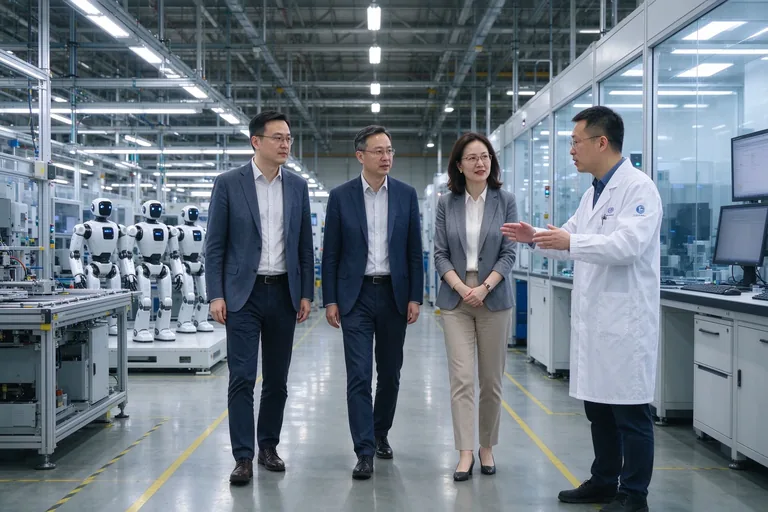
Shenzhen built its reputation on manufacturing, but most visitors only ever see the finished products — a drone in a flagship store, a robot behind glass in a shopping mall, a phone on a shelf. The actual factories where those products are designed, prototyped and assembled sit behind gated industrial buildings, and they do not sell tickets at the door.
If you want to see a real production line, you can't just show up. This guide explains how factory visits actually work in Shenzhen, what you can realistically arrange, and how to avoid wasting a trip on a showroom that calls itself a "factory experience."
There are three different levels, and they are often confused:
These are open to anyone with no appointment. You see finished products, sometimes a demo, and you can buy things. They are useful for understanding what a company sells, but they tell you almost nothing about how it is made. Many "tech tours" in Shenzhen consist entirely of these.
Some companies maintain a separate showroom inside their office or headquarters building, intended for business guests rather than shoppers. You usually see a wider range of products, technical displays and sometimes prototypes. Access requires contacting the company in advance and being hosted by a specific department.
This is what most business visitors actually want — SMT lines placing components, robots being tested, PCB fabrication running, engineers working on prototypes. These areas are never open to the public. They require a formal business introduction, visitor registration and sometimes NDAs, and access depends entirely on the company's schedule.
Shenzhen is one of the densest robotics clusters in the world. Companies such as UBTECH (优必选), EngineAI (众擎机器人) and Digital Huaxia (数字华夏) have their headquarters here. Public-facing displays exist, but deeper visits — engineering floors, testing bays, assembly areas — require a business introduction and advance registration. Major companies typically need 3-5 business days to process a visitor request, sometimes longer during trade show periods.
Shenzhen and the surrounding Pearl River Delta host thousands of PCB and electronics manufacturing factories. Some smaller factories will accept business visitors with a local introduction; larger facilities require more formal arrangements. Seeing an SMT line running a live production batch is one of the most informative visits for anyone involved in hardware.
Consumer and industrial 3D printing is easy to access through experience stores and service bureaus. For a deeper look, prototyping workshops in and around Huaqiangbei can show you the full path from a CAD file to a working part in hours.
Industrial automation companies operate demonstration lines that show robotic assembly, automated inspection and smart factory systems. These visits are particularly valuable for engineering teams and operations leaders evaluating automation.
Companies take visitor requests more seriously when there is a clear purpose — sourcing a product, evaluating a partnership, understanding a technology or benchmarking manufacturing. "We just want to look around" usually gets no response.
Major robotics companies need lead time for internal approvals. If you contact them the day before, the answer is almost always no. Build a short list and start the process early.
Cold emails to generic info addresses rarely reach the right department. Local industry associations, business networks and established hosts can route your request to the actual team that handles visits. This is the single biggest difference between seeing a showroom and seeing a production line.
Before you travel, confirm whether the visit is a public showroom, an internal company display or an actual production area. The word "factory" is used loosely in Shenzhen marketing. Knowing exactly what is arranged prevents disappointment on the day.
Floor managers and engineers typically communicate in Chinese. A local host or interpreter lets you ask technical questions, understand the process and follow up properly.
We arrange business-level factory and company visits through our local industry network — humanoid robotics companies, PCB and SMT factories, prototyping workshops and automation lines. Tell us your dates, your group size and what you want to understand, and we'll tell you what is realistic to arrange and put together a program. Company visits are subject to each company's schedule, so the earlier you start, the more we can do.
Message us with your dates and what you want to see.
Arrange on WhatsApp Tech
Tech