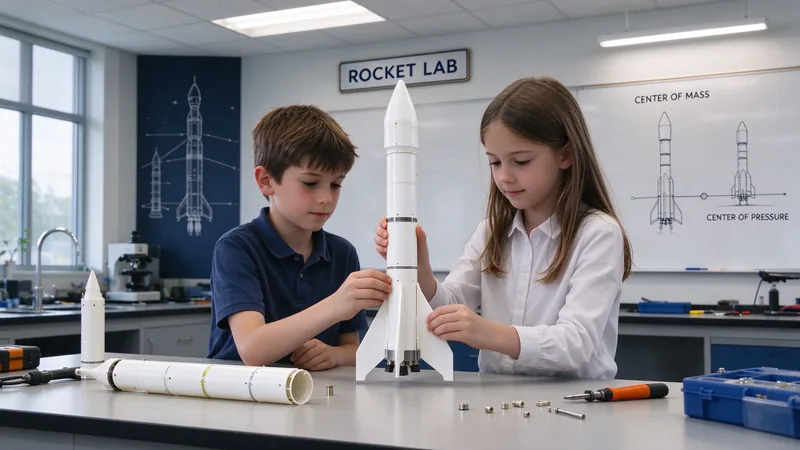
Children build a model rocket indoors and genuinely understand how it flies — thrust, gravity, balance and stability — an engineer-led session taught by a former aerospace engineer and explained in English. No live launch is needed, so the session is unaffected by weather or airspace restrictions.
The quick answer: A private, English-led session where a former aerospace engineer helps children build a model rocket indoors and understand the real principles — thrust, gravity and the balance that keeps a rocket stable. No live launch is required, so the learning is reliable, hands-on and never cancelled by weather or airspace rules.
Shenzhen has a deep aerospace and advanced-manufacturing ecosystem, and families can access expertise that is usually closed to the public. Rather than a passive museum exhibit, this session is taught by a working aerospace engineer who makes hard physics feel simple, with children building a real model themselves.
The session is led by Ding Zhiwei, a former aerospace engineer whose background gives the teaching real authority:
He is known for explaining difficult ideas in plain, approachable language — turning abstract physics into something a child can hold and test.
The engineer introduces the forces at work — thrust pushing up and gravity pulling down — and explains why a rocket stays stable rather than tumbling. The key idea is the relationship between the center of mass and the center of pressure.
Children assemble a model rocket from its sections, fitting the body, nose and fins. This is genuine hands-on work rather than a demonstration, and every part connects to a principle they have just learned.
Children adjust the fins and weight so their design is balanced and stable, seeing firsthand how a small change affects flight behavior. The idea of "keeping balance" — something they may have heard but never understood — becomes concrete through their own adjustments.
This program is deliberately designed around indoor model building and understanding, not a live launch. There are two practical reasons: temporary airspace rules in Shenzhen can restrict model and aerospace rockets at certain times and places, and indoor work is never affected by weather. More importantly, staying indoors lets children focus on the core engineering — balance, stability and how the parts work together — instead of waiting on a single launch moment. The model they build and the principles they learn are the lasting takeaway.
No live launch is required. The session is deliberately built around indoor model building and understanding the principles, so it is not affected by weather or temporary airspace restrictions on model rockets.
It is led by Ding Zhiwei, a former aerospace engineer at a CASIC institute who has led an outstanding engineering team, been featured in China Aerospace News and lectured in aerospace education with the Chinese Academy of Sciences.
Yes. An English-speaking engineer leads the whole session, translating the expert's aerospace knowledge into clear English so language is not a barrier in a Chinese-speaking environment.
It works well for children roughly ages 8 to 15. Younger children get more hands-on help, while older children can go deeper into the physics and engineering.
Yes. Rocket science pairs naturally with drone building, brain-computer interfaces and humanoid robots. We can build a multi-day future-technology program around one coherent theme.
Yes. It is a private session for your family, and parents stay with the children throughout and can take part. There are no group crowds and no fixed schedule imposed on you.
Tell us the children's ages, your dates and team size. We'll reply with a bespoke plan. Every session is private, led in English and built around indoor model work.
 Tech