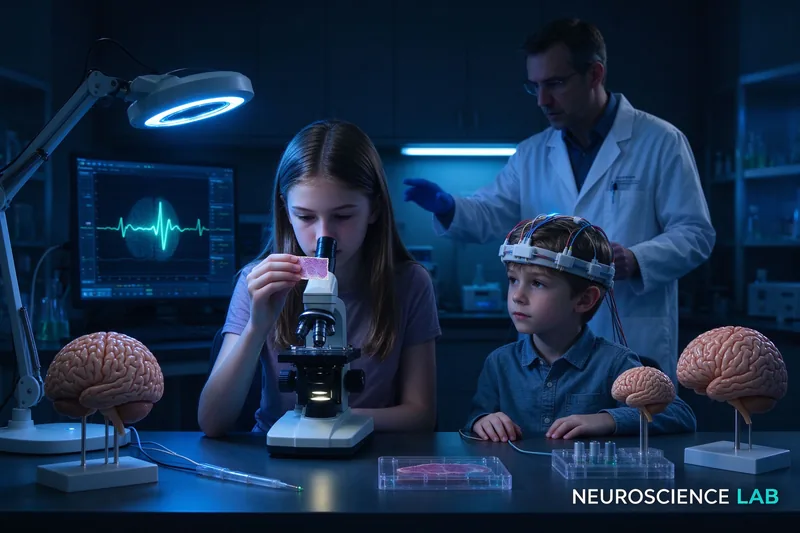
Children learn how the brain and brain-computer interfaces work, build a smart-brain model, and then use real EEG equipment to control devices and a robot dog. An optional lab adds the Guangming Brain Analysis and Simulation Facility and hands-on tissue work. It is an engineer-led, English-speaking experience at every step.
The quick answer: A private, English-led program where children learn how the brain works, build a smart-brain model, and genuinely use real EEG equipment to control devices and a robot dog. Add the neuroscience lab and they also visit the Brain Analysis and Simulation Facility and do real tissue experiments under a microscope.
Shenzhen is one of China's leading cities for brain science and intelligent hardware, home to dedicated brain research facilities, institutes and companies turning brain signals into usable technology. For a child this is rare access: rather than only reading about a brain-computer interface, they meet the real equipment and operate it themselves, with an engineer translating hard concepts into plain English.
There are two complementary parts families can choose from — a hands-on BCI course, and a real neuroscience lab inside Guangming Science City, at the Brain Analysis and Simulation Facility and the Brain Science and Technology Industry Innovation Center. They work separately or together as a single brain-science theme.
The BCI course runs in three clear stages, each building on the last.
An engaging introduction to the structure of the brain and the principles of brain waves, followed by the frontier technology of brain-computer interfaces. Difficult ideas are broken down in everyday language so children build a genuine foundation and meet the technology they will use later.
Children assemble a smart-brain model by hand, turning the theory into practice. The assembly and creative work deepen their understanding and exercise practical and spatial thinking, so they are not just listening but building something that represents what they learned.
In the final stage, children use real EEG equipment and experience the human-machine interaction of controlling devices with their own brain waves, including a robot dog. It is an immersive, hands-on encounter with a technology most people only see in headlines.
Families who want the real biology can add a session inside Guangming Science City, the core of Shenzhen's national brain-science cluster. Two landmark institutions sit there — the Brain Analysis and Simulation Facility, China's first comprehensive brain-science research infrastructure with more than 1,600 advanced instruments, and the Brain Science and Technology Industry Innovation Center, the country's first industry centre dedicated to brain-science and brain-computer interface companies.
Children enter a working science and technology infrastructure rather than a classroom exhibit, seeing where real neuroscientists study the brain from molecules and cells up to whole-brain function. The visit is framed in English, so the purpose of each instrument and the research behind it is clear.
Under specialist supervision, children carry out brain tissue staining and examine tissue slices under a microscope. They work through applying the stain, waiting, rinsing and placing the slide, use a pipette, and view real neural structures on a computer. The first time a clear neuron appears in the microscope, the word "neuron" has a concrete shape.
A BCI reads brain signals and turns them into commands for a device. In this private session children learn the principle in plain language, then use real EEG equipment to control devices and a robot dog with their own brain activity.
Yes. An English-speaking engineer leads the whole program, including the theory, model building and EEG interaction, so language is not a barrier even though the venues and labs are Chinese-speaking environments.
It works well for children roughly ages 8 to 15. Younger children can take part with more hands-on help, while older children can go deeper into the brain science and the technology behind BCI.
The BCI course focuses on brain waves and controlling technology, ending with real EEG control of devices and a robot dog. The neuroscience lab focuses on real brain biology: a research facility visit plus tissue staining, microscopy and neural imaging. They can be booked separately or combined.
Yes. BCI pairs naturally with humanoid robots, drone building and maker workshops. We can build a multi-day "future human technology" program that combines BCI, neuroscience and humanoid robots in one coherent theme.
Yes. It is a private session for your family, and parents stay with the children throughout and can take part. There are no group crowds and no fixed schedule imposed on you.
Yes. As part of the private neuroscience program, families can visit the Brain Science and Technology Industry Innovation Center in Guangming Science City — the country's first industry centre for brain-science and brain-computer interface companies — with the visit guided and explained in English.
It is China's first comprehensive brain-science research infrastructure, in Guangming Science City, with more than 1,600 advanced instruments covering research from molecules and cells up to whole-brain function. Children visit the working facility rather than a classroom exhibit.
In Guangming Science City. Under specialist supervision, children do brain tissue staining, use a pipette, examine microscope slides and view real neural imaging on a computer, usually combined with a visit to the Brain Analysis and Simulation Facility. The whole session is led in English.
Tell us the children's ages, your dates and whether you want the BCI course, the neuroscience lab or both. We'll reply with a bespoke plan. Every session is private and led in English.
 Tech